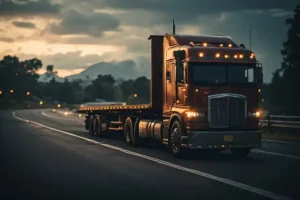
If you’ve ever sat in traffic on I-10 or the 610 Loop alongside towering trucks, you’ve witnessed the heartbeat of a global logistics hub. According to city economic reports, our region operates as a massive gateway connecting international goods to local shelves, beginning right on the water.
Consider the path of a new living room couch. While everyday packages easily fit inside a mailbox, anything requiring a pallet relies on a dedicated Houston Supply Chain Freight Delivery Service. Moving that heavy furniture from docks to nearby warehouses requires Port of Houston drayage services—specialized trucks grabbing containers straight off the ships so your goods can eventually reach your front door.
The ‘Short Hop’ Hero: Why Drayage Services are the Heartbeat of Houston Logistics
When massive metal boxes are stacked like giant Lego bricks along the ship channel, they form a bustling container terminal. These waterfront parking lots are where ocean vessels drop off everything from your new living room couch to next week’s H-E-B grocery stock. But ships don’t deliver to stores, creating a major traffic jam waiting to happen right at the water’s edge.
Moving those boxes away from the crowded docks requires a specialized short-distance truck sprint known as “drayage.” Think of Port of Houston drayage services as the crucial first runner in a relay race, hauling a container just a few miles inland to a nearby warehouse. Quickly clearing that valuable dock space is the absolute best method for reducing shipping delays at Houston ports, which ultimately keeps local shipping costs down.
Without this rapid, localized transport, our city’s commercial heartbeat would clog up with undelivered goods. Once that cargo is safely unpacked nearby, business owners face their next major hurdle: choosing between the ‘relay race’ and the ‘straight shot’ for Texas freight.
Choosing Between the ‘Relay Race’ and the ‘Straight Shot’ for Texas Freight
Once a container is unpacked near the port, goods need a ride to their next stop. Businesses must choose between two long-distance options: intermodal vs OTR freight in Texas. Over-the-Road (OTR) is the “straight shot”—a truck driving cargo directly to its destination. Intermodal is the “relay race,” combining a train for the longest stretch and a truck for the finish line.
Deciding which method wins means calculating total landed cost for Texas imports—the true final price of moving an item. Here is how the two compare:
- Speed: OTR is much faster, while intermodal takes extra days to transfer cargo between railcars and trucks.
- Distance: Intermodal shines for cross-country hauls, whereas OTR rules regional Texas routes.
- Cost: Trains burn less fuel, making intermodal cheaper for heavy, distant loads.
Smaller local shops rarely have enough merchandise to fill a massive 53-foot trailer. Instead of paying for empty space, they use Less-than-Truckload (LTL) shipping. LTL acts like a carpool for boxes, letting multiple companies share one truck and split the bill. Whether cargo rides a train or shares a highway trailer, it eventually reaches a local distribution center. From there, goods transition to the critical final phase of localized distribution.
Navigating the ‘Last Mile’: How Houston Businesses Get Products to Your Doorstep
Once your new couch or shop’s bulk inventory reaches a local facility, it faces the final hurdle: last-mile distribution in Greater Houston. This stretch from a local warehouse to a home or store is surprisingly the most expensive part of shipping. Instead of cruising down a straight highway, drivers must navigate neighborhood traffic, tight parking lots, and multiple individual stops. To manage this daily chaos, local companies rely on real-time freight tracking solutions for businesses to keep everyone informed on exact arrival times.
To speed up this final leg, many facilities use a clever logistical strategy called cross-docking. Instead of placing incoming pallets onto massive warehouse shelves, workers immediately transfer goods from large arriving semi-trucks directly into smaller delivery vans. The main advantage of cross-docking in Houston is drastically reducing storage time to deliver products faster. While moving standard boxes takes coordination, entirely different protocols are required for temperature-sensitive and oversized freight.
Handling the Heat and Heavy Lifting: Specialized Cold Chain and Heavy Haul Solutions
Keeping goods safe in Houston means battling our legendary heat, especially for the Texas Medical Center. Life-saving medications traveling down Highway 288 rely on refrigerated trailers acting like giant mobile coolers. This specialized process, called cold chain management for Texas pharmaceutical shipping, ensures delicate vaccines never reach unsafe temperatures.
Massive refinery components frequently take up two lanes on I-10, escorted by flashing pilot cars. Moving this oversized equipment requires extreme safety protocols and specialized flatbeds. When local energy companies need fast replacements to prevent shutdowns, they depend on same-day regional heavy haul delivery to keep operations running smoothly.
Mother Nature introduces her own hurdles when storms threaten the Gulf Coast. Smart businesses proactively stage extra inventory inland, managing supply chain volatility during hurricane season before flooded roads stop trucks completely. Because unique cargo and weather add major risks to your shipments, partnering with reliable logistics experts is essential to keep goods moving.
4 Questions to Ask When Selecting a Houston 3PL Partner to Protect Your Bottom Line
You now understand how heavy freight navigates our city. When choosing a 3PL partner in Harris County, local expertise guarantees reliability and safety. A team that knows our specific roads prevents frustrating delays. Audit your shipping history using this checklist of four essential questions to ask a potential 3PL provider:
- Do you have direct Port of Houston experience?
- Do you provide scalable warehousing and distribution networks?
- Are drivers specifically trained for Harris County traffic?
- How do you guarantee safety during delivery?
Start by evaluating your last delayed shipment using these metrics to ensure your supply chain remains resilient. For a trusted local guide in this freight relay race, visit LNC Logistics to explore efficient, localized supply chain solutions.
LNC Logistics
507 N Sam Houston Pkwy E Suite 202
Houston, TX 77060
Phone: (832) 777-1789
View our Google Business Listing
View our Facebook Page